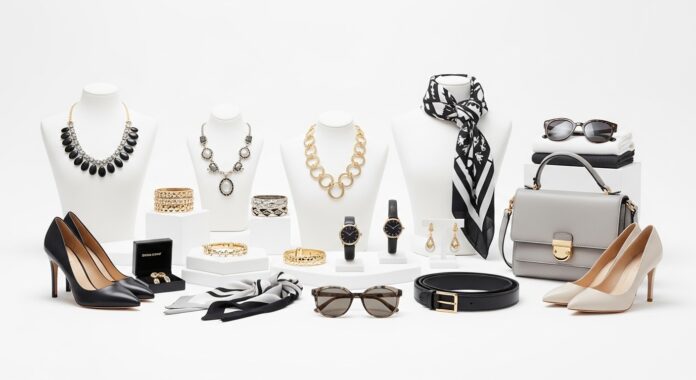
You’re getting ready for a big event, staring at the mirror, feeling like your outfit is missing something. The dress is right, the shoes are right, but there’s a gap you can’t quite name. You reach for a necklace — a simple gold chain — and the whole look shifts. That’s really what accessories do. A statement necklace, a classic watch, a good pair of earrings: none of it is decoration in the throwaway sense. It’s what turns a finished outfit into a deliberate one.
This guide walks through the actual principles behind good accessorizing — not a list of trends to copy, but the logic that lets you build your own combinations with confidence, whatever’s currently in your closet.
Accessorizing Isn’t an Afterthought Anymore
Jewelry, bags, belts, scarves, hats — these used to be treated as the last five minutes of getting dressed, added on if there was time. That’s shifted. For a lot of people, the accessories are where the actual personality of an outfit shows up, especially when the clothing itself is fairly simple. A plain white shirt and dark jeans can read as five completely different outfits depending on what’s layered on top — a chunky watch and boots, or delicate gold jewelry and low block heels, or an oversized scarf and a structured bag.
That shift matters practically, too. Accessories are usually the cheapest, fastest way to update a wardrobe — a new bag or a different pair of earrings changes an outfit more than most people expect, without requiring a single new piece of clothing.
The Core Principle: Build Around the Outfit, Not Against It
Good accessorizing comes down to balance more than any specific rule. The outfit itself should decide how loud or quiet the accessories get.
If the outfit already has a lot going on — a bold print, a bright color, a statement silhouette — accessories should generally pull back. A patterned dress paired with a delicate chain and small studs lets the dress stay the focal point. Flip that combination — a loud print plus a chunky statement necklace plus layered bracelets — and everything starts competing for attention instead of working together.
The reverse is just as useful. A simple black dress or a plain outfit in a neutral color is exactly where bold accessories get to do their job. A statement necklace, an oversized earring, or a bright bag reads as intentional rather than excessive when the outfit underneath is quiet enough to support it.
The general rule of thumb — pick one focal point per outfit, whether that’s the clothing or the accessories, and let the other stay simple — holds up across almost any occasion.
Choosing Jewelry That Actually Suits the Outfit
Jewelry is where a lot of the outfit’s tone gets set, and a few practical guidelines make the choice easier.
Necklaces follow the neckline. A plunging or open neckline has room for a longer, more dramatic necklace, since there’s space for it to sit properly. A high or fuller neckline usually works better with a shorter statement piece — a collar necklace, for instance — or sometimes no necklace at all, since anything longer just gets lost or bunched under the fabric.
Earrings can carry an outfit on their own. Large or statement earrings pair well with a simpler outfit, since there’s nothing else competing for attention above the shoulders. Smaller studs or hoops tend to suit busier outfits — patterns, layered necklaces, a lot of texture — where a bigger earring would just add to the noise.
Bracelets and rings are for texture, not attention. These sit lower on the body and read more as detail than statement, which makes them a safer place to experiment. Stacking a few thin rings or a mix of bracelets adds visual interest without overwhelming a look, especially for casual or semi-formal outfits where a single statement piece might feel too formal.
Layering: The Trend That Actually Rewards Practice
Layering isn’t limited to clothing — it’s become one of the more reliable ways to add depth to an outfit through jewelry alone. A delicate chain layered with a longer pendant necklace can turn a plain blouse into something considerably more finished, without changing the outfit itself.
The technique that makes layering work is variation — different lengths, different textures, sometimes different metals — rather than stacking near-identical pieces. Three necklaces at roughly the same length just look like one thick one; three at clearly different lengths read as a deliberate, layered look. The same logic applies to stacked rings and bracelets: mixing a thin band with a slightly wider one, or a smooth texture with a textured one, does more work than repeating the same style several times over.
The one real risk with layering is overdoing it. It’s worth taking a piece off before adding another once an outfit starts to feel busy rather than intentional — layering is a technique for building interest gradually, not for wearing everything at once.
Mixing Metals Without It Looking Like an Accident
The old rule about sticking to one metal — all gold or all silver — has mostly fallen away. Mixing gold, silver, rose gold, and even brass has become a normal, expected part of modern styling rather than something that reads as mismatched.
What keeps mixed metals looking intentional rather than accidental is usually a shared thread somewhere in the outfit — a watch in one metal paired with jewelry in another, tied together by a consistent color palette in the clothing itself. A silver watch with gold bracelets works because the rest of the outfit gives the eye somewhere to land; the same combination against a busy, multicolored outfit can read as more chaotic than deliberate.
If mixing metals feels risky, starting small is the easiest entry point — a single piece in a different metal from the rest of the jewelry, rather than an even split across everything you’re wearing.
Shoes and Bags Are Accessories Too
It’s easy to think about accessorizing purely in terms of jewelry and forget that shoes and bags are doing just as much work, if not more. A bold handbag or a distinctive pair of shoes can carry an entire outfit on its own, especially when the clothing itself is simple.
A bright clutch or crossbody bag against a neutral outfit does the same job a statement necklace would — it gives the eye a clear focal point. Printed or textured shoes work the same way from the ground up, adding personality to an otherwise straightforward outfit without requiring anything else to change.
The practical upside here is versatility: a well-chosen neutral bag and a couple of reliable pairs of shoes go with far more outfits than a wardrobe full of single-use statement pieces, which makes them some of the more worthwhile purchases in an accessory collection.
Accessorizing by Season
Accessories shift with the weather as much as clothing does, and adjusting for the season keeps a look feeling current rather than mismatched with the temperature.
Spring and summer favor lighter, simpler pieces — scarves in breathable fabric, sunglasses, minimalist jewelry that doesn’t add weight or warmth. This is also the easiest season to lean into brighter colors, since the rest of the wardrobe tends to lighten up too.
Fall and winter call for accessories with more presence and function — scarves that actually add warmth, structured gloves, hats that do real work rather than sit purely for style. Metallics, deep jewel tones, and richer textures like leather and wool tend to suit the season’s heavier clothing better than the lighter pieces that work in summer.
Building a small accessory rotation for each season, rather than relying on the same pieces year-round, makes it easier to stay comfortable and appropriately dressed without losing the sense of a considered outfit.
A Note on Trends and Social Media
Social platforms have made accessorizing more visible than it used to be — it’s easy now to see exactly how someone layered three necklaces or paired an unexpected bag with an outfit, in a way that used to require flipping through magazines or guessing. That visibility has genuinely sped up how quickly new combinations spread and get tried by other people.
It’s worth treating that inspiration as a starting point rather than a script, though. The looks that photograph well on someone else don’t always translate directly — necklines, proportions, and personal style vary enough that copying an accessory combination exactly sometimes works less well than adapting the underlying idea (a mixed-metal stack, an unexpected color pairing) to your own outfit.
A Few Common Accessorizing Mistakes
Matching too literally. Accessories don’t need to match the outfit’s exact color or the rest of the jewelry precisely — that tends to look flat rather than polished. A near-match or a deliberate contrast usually reads as more considered than an exact one.
Overloading a single outfit. A statement necklace, big earrings, a bold bag, and patterned shoes all at once is rarely the win it feels like while getting dressed. Picking one or two focal points and keeping the rest simple almost always looks more put-together than trying to feature everything at once.
Forgetting scale. A delicate necklace can disappear against a heavy sweater, just as a large statement piece can overwhelm a lightweight blouse. Matching the visual weight of the accessory to the visual weight of the fabric it’s sitting against makes a bigger difference than most people expect.
Building a Capsule Accessory Collection
A well-chosen small collection of accessories tends to serve an outfit better than a large one bought piecemeal, mostly because a handful of versatile pieces can be recombined far more times than a drawer full of single-use statement items.
A reasonable starting point covers a few categories: one or two neutral bags that go with almost anything, a couple of pairs of reliable everyday shoes, a simple gold or silver jewelry set for daily wear, and then a smaller number of bolder pieces — a statement necklace, a printed scarf, a pair of eye-catching earrings — saved for outfits that call for them specifically. The everyday pieces get the most wear and are worth spending a bit more on for that reason; the statement pieces can be more experimental since they’re worn less often and matter less if a trend passes.
It’s also worth periodically auditing what actually gets worn versus what sits unused. Accessories are easy to accumulate without noticing, and a collection that’s grown too large often ends up harder to style from than a smaller, more deliberate one — too many options can slow down getting dressed just as much as too few.
Final Thoughts
Accessories are one of the few parts of getting dressed where small changes have an outsized effect — a different necklace, a bolder bag, a mix of metals instead of one, and an outfit reads completely differently without a single piece of clothing changing. The principles hold steady regardless of trend cycle: build around the outfit rather than against it, keep one clear focal point, and match the accessory’s presence to the outfit’s own. Once that logic clicks, accessorizing stops being a guessing game and starts being one of the more enjoyable parts of getting dressed.

