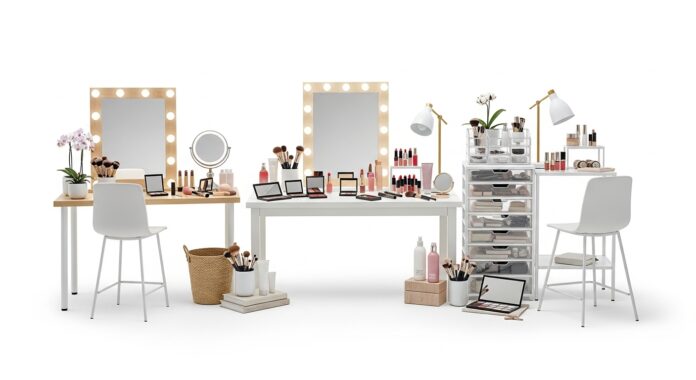
Emily, an avid makeup lover with an ever-growing collection of products, found herself struggling to locate her favourite lipstick amid a chaotic mess of tubes, brushes, and palettes. Frustrated, she realised her disorganised vanity was holding back the part of her day she actually enjoyed — getting ready had turned into a search mission. Determined to fix it, she went looking for storage solutions that actually matched how she used her products, not just something that looked good in a photo. What she ended up with was a sleek, functional space that made her routine noticeably smoother.
Emily’s experience isn’t unusual. A makeup collection that grows faster than the storage around it eventually starts working against you — misplaced products, wasted time, and a vanity that’s more stressful to look at than enjoyable to use. This guide covers practical storage solutions, how to actually organise a growing collection, and the maintenance habits that keep it from sliding back into chaos.
Why Makeup Storage Is Worth Getting Right
Good storage does more than tidy up appearances. It genuinely changes how your routine feels day to day — being able to find what you need without digging through a drawer saves real time, especially on busy mornings. It also protects your products: cosmetics exposed to light, heat, or humidity break down faster, and products left open or jumbled together are more prone to contamination than ones stored properly.
There’s also a financial angle. Makeup isn’t cheap, and losing track of what you own leads to duplicate purchases — buying a lipstick you already had, just because it was buried somewhere you couldn’t see it. An organised system makes it much easier to actually see and use what you’ve already invested in.
Creative Makeup Storage Ideas
Acrylic organizers. Clear acrylic storage has become a go-to option for a simple reason: visibility. Being able to see every product at a glance makes it far easier to grab what you need without opening multiple drawers. Acrylic units come in a wide range of configurations — stacked drawers, tiered stands for brushes, rotating towers for a countertop — and they’re durable enough to hold up to daily use without yellowing or cracking quickly if kept out of direct sun.
Drawer dividers. For anyone who prefers to keep makeup out of sight rather than on display, dividers turn a chaotic drawer into a genuinely organised one. They’re particularly effective for smaller items — lipsticks, eyeliners, brow pencils — that tend to roll around and get lost in an undivided drawer. Adjustable dividers are worth the small extra cost, since they can be reconfigured as your collection changes.
Wall-mounted shelves. For limited counter space, shelving that moves storage onto the wall frees up the surface for actually getting ready. It also doubles as a display, since open shelving puts your products (and their packaging, which is often part of the appeal) on view rather than hidden away — worth considering if your collection includes products you actually enjoy looking at.
Pegboards. A pegboard offers a level of flexibility other storage types can’t match — hooks, small shelves, and bins can be rearranged as your collection and habits change, rather than committing to a fixed layout. This makes them particularly useful for people whose routines or product mix shift fairly often.
Rotating organizers. A 360-degree rotating unit keeps a large number of products accessible in a relatively small footprint, since you’re accessing the full storage by turning it rather than reaching around it. These work especially well for larger collections that need to stay on a single countertop rather than spread across multiple pieces of furniture.
Vintage suitcases and trunks. For a storage solution that also adds character to a room, a vintage case or trunk offers real capacity while doubling as a decorative piece. It’s a good option for anyone who wants their storage to look intentional rather than purely functional, though it suits a curated collection better than one that’s still actively growing, since these tend to have less flexible internal space than modular options.
Tips for Organizing Your Makeup Collection
Categorize your products. Group similar items — lipsticks with lipsticks, eyeliners with eyeliners, foundations with foundations — rather than storing everything by brand or by when you bought it. Category-based organisation is what actually speeds up finding things later.
Separate by frequency of use. Keep what you reach for daily in the most accessible spot, and move seasonal or occasional-use products — holiday palettes, a specific event look — somewhere less prime. This single habit does more for day-to-day convenience than almost any storage product.
Label containers and drawers. A simple label system removes the guesswork of which drawer holds what, particularly useful for opaque storage where you can’t see contents at a glance. It also makes it easier for anyone else using the space — a partner, a roommate — to put things back where they belong.
Declutter regularly, with real expiration guidance in mind. Makeup doesn’t last indefinitely, and different product types age at very different rates. As a general guide: mascara and liquid eyeliner should be replaced roughly every three to six months, since they’re repeatedly exposed to air and bacteria with use. Foundation and concealer typically last around a year. Lipsticks and lip glosses tend to hold up longest, often a year to two, while powder products — eyeshadow, blush, pressed powder — generally have the longest shelf life of all, often up to two years with proper storage. Signs a product has gone off regardless of how long you’ve owned it: a change in smell, texture, or colour is a clearer signal than the calendar.
Storage Habits That Prevent Future Clutter
Store products away from heat and direct sunlight. Both accelerate breakdown, particularly in liquid and cream formulas. A drawer or a shaded shelf preserves products considerably longer than a spot near a sunny window or a radiator.
Keep lids and caps secured. Beyond the obvious mess-prevention, this reduces air exposure, which is one of the main things that shortens a product’s usable life once it’s opened.
Clean your tools alongside your products. Storage habits only go so far if the brushes and sponges going back into that beautifully organised drawer aren’t clean. Dermatologists generally recommend washing makeup brushes every seven to 10 days, since buildup on tools can undermine the hygiene benefits of good product storage.
Do a seasonal review. Rather than waiting for a drawer to become unmanageable, a quick check every few months — pulling out anything expired, reassessing what’s actually getting used — keeps a storage system working the way it was designed to, instead of slowly refilling with clutter the same way it did before.
Build in room to grow. A storage system sized exactly to your current collection will need replacing the moment you add anything new. Leaving a bit of extra capacity, even a single empty drawer or shelf, saves a full reorganisation down the line.
Storage Solutions for Smaller Spaces
Not everyone has room for a full vanity setup, and a lot of genuinely good storage ideas scale down well for a shared bathroom, a small bedroom corner, or a single shelf in a closet.
Stackable containers make the most of vertical space when floor or counter footprint is limited. A few smaller stacked units, rather than one wide organiser, often fit awkward corners and shelf heights that a single large piece can’t.
Over-the-door organisers use space that’s otherwise completely wasted — the back of a closet or bathroom door can hold a surprising amount of product in slim pockets without taking up any floor or counter space at all.
Multi-use furniture — a storage ottoman, a cart that can move between rooms, a caddy that tucks under a sink — suits anyone who doesn’t have a dedicated beauty space and needs storage that can be put away or relocated as needed.
Edit before you organise. In a small space especially, the most effective “storage solution” is often a smaller collection. Decluttering expired or unused products before buying new storage means you’re not building a system to house things you don’t actually need to keep.
Matching Storage to Your Budget
Good organisation doesn’t require an expensive setup, and it’s worth thinking in tiers rather than assuming the priciest option is automatically the best fit.
Budget-friendly: Repurposed containers — mason jars, cutlery trays repurposed as drawer dividers, shoeboxes — cost little to nothing and work as well functionally as their branded counterparts, if less polished visually. This tier suits anyone still figuring out what storage style actually fits their routine before investing further.
Mid-range: Purpose-built acrylic organisers, drawer divider sets, and modular stacking units hit a reasonable balance of durability, flexibility, and appearance without a major investment. For most people with a moderate, ongoing collection, this is where the best value tends to sit.
Higher investment: Custom vanity builds, integrated lighting, and furniture-grade storage suit people with large, established collections or anyone treating their beauty space as a genuine room feature rather than a functional corner. This tier makes the most sense once you have a clear, stable sense of your storage needs, rather than as a starting point.
There’s no requirement to move up tiers — plenty of well-organised collections run entirely on budget-tier solutions. The goal is matching the system to how much you actually own and how often it changes, not matching it to what looks most impressive.
Designing a Space You Actually Want to Use
Storage function matters most, but the way a space looks affects how much you actually enjoy using it, which is worth factoring in alongside pure practicality.
Consistency in containers — matching acrylic, a unified colour palette, similar-shaped jars — makes even a fairly full collection look considerably calmer than a mismatched assortment of whatever containers happened to be on hand. It’s a small design choice with an outsized visual effect.
Lighting matters more than most people initially budget for. A well-organised vanity is still frustrating to use in poor lighting, since applying makeup accurately depends on being able to see true colour and texture. A dedicated light source — ideally one that approximates natural daylight — makes a bigger practical difference than most storage upgrades.
Leave a clear working surface. However good the storage, a vanity that’s entirely covered in organisers with no open space to actually apply makeup defeats the purpose. Reserve a section of counter or desk purely for application, separate from where products live.
Final Thoughts
Emily’s shift from a cluttered vanity to an organised, functional space wasn’t really about any single product or container — it was about matching storage to how she actually used her collection, then keeping it maintained rather than letting it slide back into chaos. Whether you land on acrylic organisers, drawer dividers, a pegboard, or a mix of several approaches, the right system is the one that makes your actual daily routine easier, not just the one that photographs best. Get the storage right, and the rest of the routine tends to follow.

